





Your Style Is Not Lost.
Every week, hundreds of thousands of women type the same hopeful question into Google: “How do I find my personal style?”
They think they want a quiz or a Pinterest board. Or diving into ‘capsule wardrobe essentials’ which somehow always include a white button-down shirt and a trench coat. Then, a few weeks later, they’re standing in a closet full of them feeling like they have nothing to wear, and no closer to understanding why.
Here’s what a lot of style advice won’t tell you: the reason you can’t find your own style is that you’ve been looking in all the wrong places. Your style has never been hidden from a quiz result, body shape, or trend report. It was waiting for something much deeper than that.

The style is not available. It is revealed, layer by layer, starting with who you really are.
The Problem With ‘Finding’ Your Style
The language itself is expressive. We talk about finding our style as if it were something lost, something foreign that we need to find and bring home. But style is not a thing. It’s not a habit. It’s not even, basically, about the clothes.
Style is a form of self-expression. And you can’t express yourself if you haven’t taken the time to understand it.
This is why most style quizzes reliably fail. They ask you what you like, ‘minimalist or maximalist?’, ‘classic or edgy?’ and then assign a beauty based on your answers. Even if one person’s brand of maximalism is another person’s minimalist vibe. I remember one such conversation with a client. When I asked her about her style, she told me that she likes “simple” and yet when I looked at her favorite clothes in her wardrobe, “simple” was not the word that came to my mind. His “simple” clothes have asymmetry, some pattern or other unique details.
Classic is another style word with little overlap from one person to the next as to what it means. You can check out my post about the two Classic versions here and how they are very different.
But aesthetic is not style. An aesthetic is a mood board. Don’t get me wrong, mood boards are a very useful tool when identifying your style, but just like a hammer is useful for building a house, you also need nails, a level, a screw driver, a saw and many other tools.
True style is the intersection of who you are, how you live, and what you want to communicate to the world. It is deeply personal, which means it is also deeply individual, and no algorithm can calculate it.
Finding Personal Style is an active endeavor
Research on identity-based self-concept (Swann, 1983; Harter, 1999) shows thatauthentic self-expressionit’s aa primary psychological need.
Let me repeat that.
Authentic self-expression is an important psychological need.
Style is shallow, and it doesn’t care what you wear.
When there’s a gap between how we present ourselves and who we believe we are, it creates what researchers call ‘self-confusion’, the chronic low-level discomfort many women attribute to their wardrobe without realizing it stems from something much deeper.
Why Personality Comes Before Aesthetics
In my work with thousands of clients over twenty years, I have noticed that the most stylish women, the ones who walk into the room and think, ‘you have something’, share one quality that has nothing to do with their budget or their body. They dress to match. What they wear is like who they are.
They don’t dress to “fit in” or blend in.
That’s why I start every client relationship not with a wardrobe check or a shopping list, but with personality. I use a number of tools to help me, including personality dressing styles, which show the overlap between personality traits and what feels right to wear. I also use a form of psychology, based on the work of Carl Jung, as a lens to understand the essence of the client before we look at a single garment.
Because here’s what I found: an INTJ woman and an ENFP woman don’t just have different personalities. They have different visual languages. Different powers. Different values they want to express. And if we put them both in the same ‘capsule closet’, one of them will feel like he’s wearing a costume.
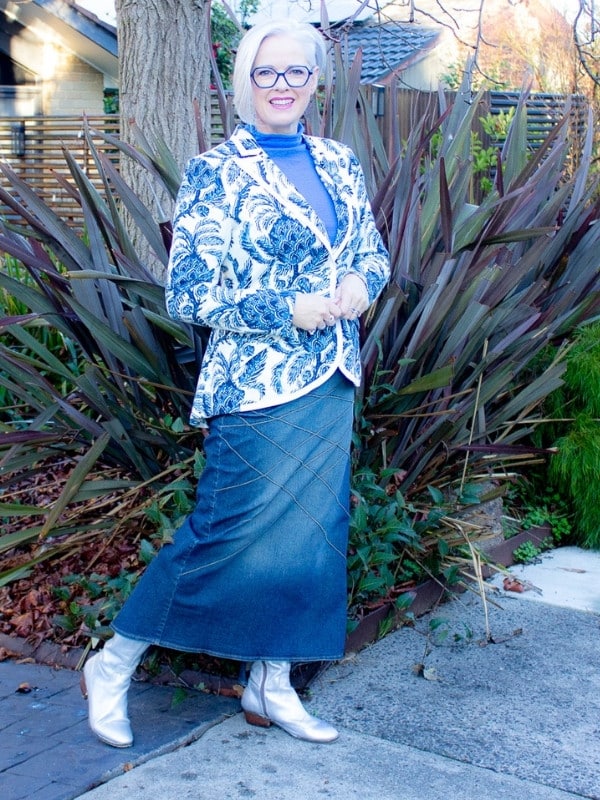 The most common style mistake is not buying the wrong clothes. Buying clothes that fit someone else’s lifestyle.
Psychological research on personality and aesthetic preferences (Rentfrow & Gosling, 2003; Borkenau & Liebler, 1992) consistently shows that personality traits are expressed through aesthetic preferences, music, interior design, and, of course, clothing. We are not blank slates on which fashion writes itself. We bring ourselves completely to the way we dress, whether we realize it or not.
The question is whether you wear it intentionally, from the inside to the outside, or accidentally, from the outside to the influence of others.
The Danger of Borrowed Aesthetics
We live in an age of beauty. On social media, ‘beauty’ has become a whole subculture: cottagecore, clean girl, beach granny, dark school, quiet luxury. They are well made. They are graphically compelling. And, for most of us, they don’t matter at all.
Not because these beauties are wrong, but because they were created by other people, because of other people’s lives, personalities, bodies, and budgets. When we use someone else’s aesthetic wholesale, we borrow their visual language without understanding our own. The result is a cupboard full of ‘wish’ pieces that sound a little off, like words that don’t quite fit into a sentence.
What This Looks Like in Use
Think of a woman who decides that she is going to be a person of ‘comfortable peace’. She invests in a beige cashmere jumper and wide leg trousers. He follows the rules carefully. But she’s a clear, expressive, warm person who fills every room she’s in, and the understated palette and slim silhouette make her feel, somehow, small. He is not like her. He looks like a rejected version of himself.
This is not an aesthetic failure. The mismatch between beauty and the wearer.
‘Confusion of Style’ Is a Sign of Self-Awareness, Not a Mistake
Here’s something I want you to keep in mind: just because you feel confused about your style is not proof that you have bad style. It’s proof that you’re paying attention.
Women who stress the most about their clothes are often the most self-conscious; they can feel the gap between the way they present themselves and the way they want to be seen.
They know something is off, even if they can’t explain what it is. That sensitivity is not a problem to fix. It’s a compass.
Women who don’t question their style are often women who have stopped paying attention. They have settled into the uniform, their version of the decade, not out of clarity, but out of habit.
Your discomfort points you somewhere. The question is whether you are willing to follow it past the quick fix of a new dress and into a deeper place of self-understanding.
Your style confusion is not a problem. It is the beginning of the solution, if you know how to read it.
The Question That Changes Everything
Before you buy anything, before you fill another online cart, book another shopping trip, or add another ‘maybe’ to a Pinterest board, I want you to stay with one question:
Is this for me? Or is this wishful thinking?
‘Mine’ means:Does this match who I really am, how I live, and what I want to say?
Not who I want to be. Not who I am on a good day. Not who I would be if I had a different body, a different job, a different life.
‘Aspirational’ means:this represents my unfinished version. And buying what you want is one big reason why closets are full of unworn clothes.
I’m not saying that longing is wrong. I say it must be true. There’s a difference between wanting to find a more confident, expressive version of yourself and wanting to be with someone who has nothing to do with who you are. And in my experience, getting to that authentic, desirable version of yourself is done in baby steps, one small tweak at a time, not by adopting someone else’s perfect look.
Where Style Really Begins
True personal style is built on four foundations. In my 7 Steps to Style program, we work through all of this systematically, because style is a skill that can be learned, and like all skills, it has a method. But even before the methodology, these four basics need to be understood:
Who you are. Your personality and values
Not who you are on your best day, or who you think you should be. Who you really are – your attitude, your strengths, your core values. This determines the ‘essence’ your style should convey.
The way you live. Your lifestyle and context
A style that doesn’t work in your real life isn’t a style; costume. Your wardrobe should work for the life you live now – not the life you had when you were 35, not the life you might have when you take that sabbatical.
Your body, colors, and proportions. Your physical reality
Not as obstacles to overcome, but as distinct boundaries within which your style works. Your color, your measurements, your comfort preferences – these are data points, not limitations.
What you want to say. Your communication goals
Every item sends a message before you even open your mouth. What do you want yours to be? Skill? Creation? Warmth? Authority? Accessibility? Your style is a constant conversation you have with the world, whether you know it or not.
When these four foundations are aligned,dressing ceases to be a problem to be solved and becomes an act of self-expression. You don’t find your style at that time. He lives there.
Women who come to me feeling very lost in their style are often women who are close to true success. The confusion they feel is a natural consequence of having one version of themselves and not yet revealing the next.
If that’s where you are, I want you to know: your style is not lost. It’s waiting, under quizzes and Pinterest boards and ‘shoulds’ and ‘musts’, for you to be curious enough to look at.
Not outside. Inside. This is where all real style begins.
Want to test your style basics?
It all starts with understanding your identity, identifying your needs and what makes you feel strong, and I will show you how with my masterclass E³ Resetting Your Style, I will give you a tool that will make you look at every outfit and accessory in your wardrobe in a new light. It’s about clarifying where you go right and wrong with decisions so that all decisions are more effective and personal.
