
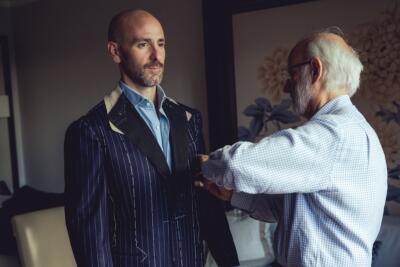

By Fred Schlatter.
Fred is an American PS reader we’ve known for a while, and enjoyed talking to. Following a recent conversation about his journey in menswear, we invited him to write an article about it, as many aspects of it we felt would chime with the readership.
Like many here, I suspect, my personal history with clothes falls rather neatly intobefore bespokeandafterbespoke. Perhaps unusually, there’s also a brief return to ready-to-wear, a dark agesof sorts,followed by a renaissance, which I suppose is where I find myself today. But more on that later.
In the earliest time before bespoke, I’m in school. I spent those years between a few preparatory and boarding institutions, the duration of each stay dependent on the degree of tolerance for me. A couple were more casual, but most required chinos, a collar, frequently a tie and often a jacket. The last of these schools – the one that begrudgingly let me graduate – expected the full prep rig, right down to the Weejuns.
If you were on a varsity sports team, as I was, you travelled in it. I distinctly recall arriving at wrestling or lacrosse matches at some rival campus and knowing our repp ties and blazers intimidated our opponents.
Did it project strength, like armour? Maybe. But I think it had more to do with the tension between propriety and the ensuing organised violence. Either way,getting dressedgained something beyond the practical.
Because those prep school years weren’t all happy ones, I don’t hold the Ivy look in particularly high regard. For me, they are just the clothes I wore to school, and they still reek of pilfered beers and cheap cologne around the back of some crap dormitory.
Far more interesting to me were the British and Continental styles I saw in action as a boy. (I was born in Tokyo to a British mother and Swiss father, and grew up just outside of NYC and later Chicago).
In university I discovered my father’s castoffs – less the eighties and nineties power tailoring he wore daily, but the older stuff. A seventies sports jacket in brown houndstooth with slate overcheck from Harrod’s. A sixties Pierre Balmain tux with a slinky lapel. A midnight velvet jacket with patch pockets and swelled edges of unknown French provenance.

And casual stuff, like a pastel Pringle sweater with an exploded argyle, and a tan and navy Dior Breton stripe top – stolen, I might add, by a girlfriend (Samantha, call me – no questions asked).
I wore these to threads, alongside a steady diet of 501s. Jeans and sports jackets became a sort of uniform, its mix of prep and punk providing a tension I felt suited me.
In my early working life I began replacing the vintage stuff with ready-to-wear from Ralph Lauren and Paul Stuart. I had some shirts made at the latter, and then a few suits and jackets through their made-to-measure programme. I got married in a Paul Stuart dinner suit that had been thoughtfully adjusted from the block pattern. It was pretty good. (The tux – the wedding was excellent).

If you’ve made it this far, you can probably guess what happened next. As good as made-to-measure can be, if you are particular, there will always remain things you’d change. For me it was a wider lapel, less structured shoulders and higher rise trousers. I wanted something more permanent – tailoring that would last me a lifetime, not just in terms of quality, but in style.
I had read about Chris Despos, the respected American bespoke tailor, and, as it happened, he had an atelier in Chicago, perhaps a four minute walk from where I was then living. In fact, I could just about make out the building from my bedroom window. Sliding into bespoke was inevitable.
We began with a navy suit in 13 ounce H Lesser. A 14 ounce Porter and Harding brown herringbone jacket came next. And then another suit in H Lesser, this one a mid-grey sharkskin three piece. Reading that back tempts me to pat my former self on the back for having restraint. And so began my bespoke era.

Despos cuts an interesting style. The shoulder gives the impression of structure, but has no padding whatsoever; the chest is swelled rather than draped; the waist smartly nipped. The quarters are relatively open; the gorge height moderate, just below my collar bone.
His lapels deserve an essay of their own, but, in short, are generous with a sumptuous roll that simultaneously projects strength and fluidity. It’s a flattering line.
More followed. A Fresco grey windowpane; a tropical worsted navy pin-dot; a tobacco Irish linen; a flannel three-piece glen check with rust overchecks. In between came hopsack blazers, a few more tweed and lightweight odd jackets, and trousers in gabardine, flannel, whipcord and cotton. And for evening, a magnificent midnight double-breasted suit and a mohair tuxedo.
In just over a decade (during which kids and the founding of a food company also took place), Despos and I had orchestrated an enviable wardrobe. I would have happily continued, but for two plot twists.

While Despos was (and remains) full of energy, his coat makers and finishers did not. Production slowed considerably, and his backlog grew. In early 2019, I had a first fitting on a dusty blue-cotton suit and navy shepherd’s check lightweight odd jacket. Despos and I only met a few weeks ago for the second fittings, seven years later.
The other wrinkle, one can guess, was the pandemic. Days before the lockdown, my wife and I hastily decided to leave Chicago for the Gulf Coast of Florida to look after my mother. What we thought might be a few weeks turned into six months.
I spent the time working, fishing, paddle boarding, lifting heavy things and cooking. Fish replaced hearty Midwestern food. I grew a beard, and, I’m not ashamed to admit, more muscular. Forget tailoring; I barely wore anything.

We returned to Chicago, but whatever feelings we had for the place were gone, so we moved to Miami.
If you’ve ever visited, you know Miami offers a vibrant and varied culture, but one that leans into its reputation for nightlife and tropical leisure. Not exactly the place for tweeds and flannel, and so I stored much of my tailoring. Some of the lightweight stuff got used, but even something like a linen suit felt odd post-pandemic as we made new friends and acculturated.
I wouldn’t say I embraced fashion, but it was amusing to play at the edges. Some slimmer jeans were followed by a few questionable tops. I played with unusual accessories, and experimented with more adventurous facial hair styles. I bought a few ready-to-wear jersey jackets, as unstructured as they were unserious.
I didn’t realise it in the throes of novelty, but this was probably the dawn of middle age masquerading as reinvention. In retrospect, it seems like a dark age, if for no other reason than I knew it wasn’t me.

Several years ago, having sorely missed travel during the pandemic and subsequent move, we found ourselves in London on Boxing Day. The idea was to spend a few nights in the city, and then host a New Year’s party at a rented country house in North Wales for family and friends.
I packed that first navy suit Despos made, a couple pairs of flannels, a tweed or two, and my favourite blazer – a plush hopsack from Drapers’ Bingley bunch.
The evening we arrived, I slipped into the suit and – at the risk of over romancing things – it felt like I had come home. It reminded me of the scene fromI’ll Sleep When I’m Dead,in which Clive Owen puts on his old suit, except I wasn’t a vengeful gangster coming out of retirement, but a guy stepping out to dinner – to Wilton’s, incidentally, where the fish pie and a bottle of Chablis sealed the impression.
I’m sure I’m not the only clothes nerd to feel the transformative effect of an evening in good tailoring, but I reckon I’m one of the few to wake in the morning with the sort of guilt an adulterer must experience shortly after the blinds go up. In the sobriety of morning light, there my suit hung, silently asking why I had strayed.
The rest of the trip was a blur of flannel, tweed, shepherd’s pie and claret. A renaissance was afoot, and I returned to the States with intent.

The first step was an honest inventory of my wardrobe – both past and present. Out went the ready-to-wear, replaced by the suits, jackets and trousers Despos first made me. It had only been a few years since stashing them, but I had the very real sense I was welcoming back old friends.
I brushed the lapels, slipped into several, and made two unwelcome discoveries. Moths had had a go at a few of them, but nothing a skilled reweaver couldn’t mend. The bigger project was going to be alterations. I knew I slimmed down and muscled up, but I didn’t realize how dramatic the change was.
Fortunately, the jackets seemed fine in the shoulders, they just needed a nip in the waist. The trousers, though, required significant surgery.
The truth is, in an attempt to future-proof my wardrobe, I probably had them cut too full initially – which makes sense, considering I commissioned most during the height of the first #menswear era. I would caution anyone starting out to beware of internet wisdom, no matter how authoritatively it’s proffered.

Despos developed a new trouser pattern, and has slowly been altering my old pairs to match it. Of course I wouldn’t be much of a tailoring enthusiast if I didn’t order new things, and so half a dozen odd trousers in Drapers Ascot, Portofino linen, Finmeresco and Fox flannel came in rapid succession.
He also had a couple of interesting lengths abandoned by former clients that I gladly claimed, including a vintage Smith’s Solaro and a luxurious navy rope stripe in semi-milled worsted. I recently had a fitting on the latter, and it’s heartening to see Despos back at it, pins clenched between teeth.
Partly out of curiosity, I’ve started projects with other tailors. My brother lives in New York and uses Paolo Martorano, and as I’m there often, thought I’d give him a go.

His ‘New York Refined’ house style is very different from what I have; it’s more structured, perhaps more conservative and certainly more British in line. The work is good, and the turnaround time so far excellent. He’s an amiable guy, and we get along well.
I also ordered a suit in Art du Lin and a blazer in Drapers Montecarlo hopsack from Vittorio Salino, the Florentine tailor formerly of Liverano. I’m encouraged by what I’ve seen so far in fittings and a finished piece.
I’m drawn to the Florentine cut for its softness and masculinity, with echoes of some Despos jackets I have, but slightly more dramatic in some ways. Vittorio and I get along very well – “like two peas in a pod,” as my wife put it, which may or may not have been a bald joke.

That brings us to today. It’s trite, I realise, but one really does learn lessons about oneself along the way, and the urge to look back and offer advice to a former self can be overwhelming.
For instance, while I applaud my conservative choices early on – and despite what every menswear authority advises – I would have encouraged me to have more fun. “You’re not a lawyer, for heaven’s sake!” I’d say with a knowing wink.
I’d also tell pandemic mid-life crisis guy to embrace the weirdness with two hands – it might not have been me, but who cares? The occasional vacation from oneself can be liberating and informative in equal measure.
So what remains? Despos and I have been messing about with frog mouth pockets on trousers and an interesting jeans pattern. We’re doing a safari suit in black deadstock hightwist – which sounds questionable, I realise, but might be just the thing for tropical cocktail attire.
I want a covert coat – maybe through Paolo, and adoppio usoovercoat by Vittorio. But, really, what sort of question is that? For the enthusiast, everything remains.
Photography: Nasko Kan
