





How to Use Your Color Palette Without Feeling Restricted (or Confused)
“Why can’t I find the right dress for my colors?”
A dear reader asked me this recently, and if you’ve ever stood in a fitting room wondering why something “matches your palette” but still feels off… you’re not alone.
Let’s get something out of the way first.
Your color palette is not a paint-by-numbers set.

It is not a strict rule book.
And it’s not 50 tiny swatches that you have to match with research accuracy.
It is a framework.
And once you understand how to use it properly, shopping becomes much easier.
Your Palette The Ultimate Summary – It’s Not The Whole Book
There are more than 50,000 colors you can wear.
Your palette? About 50 of them.
I call it the ultimate summary.
It’s there to show you the color properties that work for you, not to limit you to exact matches.
When you buy, you don’t ask:
“Is this the exact same red?”
You ask:
- Does this color match my palette?
- Is it the right tone?
- Is it the right fit?
- Is it the right amount (brightness or depth)?
We want harmony, not repetition.
Think siblings – not distant cousins.
What “Integration” Really Means
If the color works for you, it’s like you belong in the same family.
It’s not the same.
Not copied and pasted.
It’s just relative.
If your palette contains blue-pinks, coral (which leans warm and orange) will feel different – even if it’s technically “pink.”
If your palette is light and airy, a deep, heavy pattern will feel heavy – even if the colors themselves are the same.
What trains your eye to see:
- Undertone (warm or cool)
- Power (soft or clear)
- Value (light, medium, deep)
That’s the plan.
And once you understand the system, you stop second guessing yourself.
Patterns: The Law of Majority
Patterns confuse people — but they don’t need to.
When looking at a printout, ask:
- Do most of these colors stay in my color family?
- Does the overall feel match my palette?
If most colors match your undertone, value, and intensity, it works.
If the greens are more olive when you’re cool or more emerald when you’re warm…
If blue is too bright on your palette, if you smoke, or too cool on your palette, if you are warm
If pinks lean towards coral then you need blue based because you’re cool…
It won’t sound consistent.
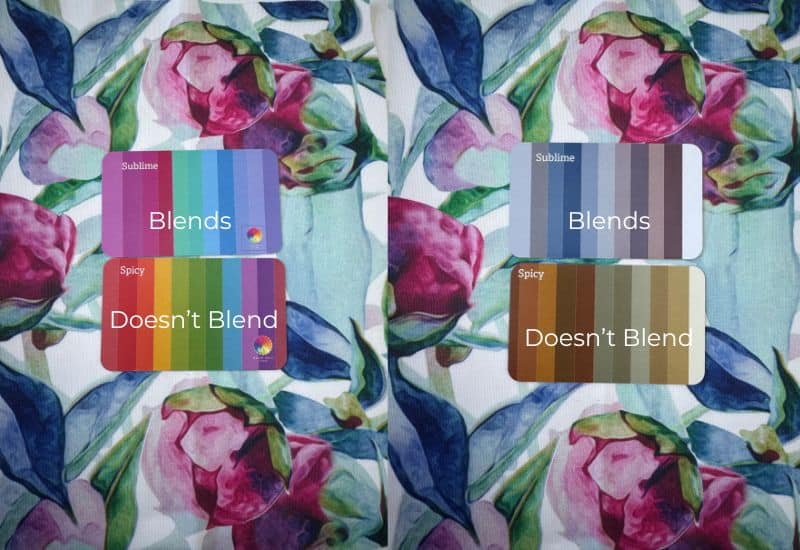 And that subtle disagreement often makes you say:
“There is something wrong with this.”
Your instincts are usually right. You didn’t have the framework to explain why.
Now you do.
Check out my post here on choosing patterns to work with your palette.
The Black Myth (And Why Many Women Think They “Can’t Wear It”)
Every season, fashion determines which color is temporary.
Recently we have seen olive, camel, burgundy and chocolate brown.
I often hear people say:
“I can’t wear brown.”
And I used to think that was true of me too, even though I had dark chocolate brown hair – which suited me perfectly.
What I learned from personal color analysis training is that you can wear brown, regardless of your undertone; it’s just that you can’t wear all brown.
As with all other colors (excluding orange, which is always warm, and black, which is always cool), there are both warm and cool shades of brown, which I wrote about here.
Cool palettes need cool, pinky/purple browns.
Warm palettes require golden, copper and orange browns.
The same color name can live in completely different subfamilies.
There are also light browns for those with a lighter ideal, which is you if you have lighter hair colors, going into beige and camels, as well as traditional dark brown shades.
That’s why trying on “brown” and being told it’s impossible is like trying on one pair of jeans and deciding that denim doesn’t fit you.
The problem is not class.
Color properties.
Why This Is More Important Than You Think
If your colors are matched:
- Your wardrobe is easily mixed and matched.
- Getting dressed takes less mental energy.
- You look put together without trying too hard.
- Stop buying near-misses.
And perhaps most importantly:
You start to trust your eye again.
For many smart women over 40, the real struggle isn’t color.
Confidence.
She has spent decades dressing for roles. Clothing. What is expected.
Now you ask:
What actually works for me?
Color analysis is not about control.
It’s about clarity.
And clarity builds confidence.
The Easy Way to Buy with Confidence
The next time you pick up a dress, don’t ask:
“Is this my palette?”
Ask instead:
- Does it sound like the same family?
- Is the undertone aligned?
- Is the price the same as what suits me?
- Is fitness consistent?
You don’t need to lug around a suitcase of swatches.
You need to understand the plan behind them.
Style is not about rules.
It’s about making informed decisions, aligned with principles that support how you want to feel.
And when your colors match – really match – everything else becomes easier.
If this sounds familiar, you might gently ask yourself:
- Was I treating my palette as a limitation instead of a guide?
- Where am I still trying to match exactly instead of matching?
- What would change if shopping felt meaningful instead of frustrating?
Because style is not a guessing game.
It is a science.
And once you get the hang of it, getting dressed becomes one of the easiest, and most empowering, parts of your day.
Find Your Own Optima Color Palette
If you are interested in finding your best color palette and how to wear it, you can find an online color analysis with my 18 Absolute Color System palette here..
