


Most women don’t hate their arms because of the shape. They hate them because the skin has changed. It becomes softer, saggier, or crepier, and suddenly the sleeves that never bothered you before are the first thing you notice. I understand because I have had the same thoughts.
But here’s what I’ve learned: it’s usually not your arms at all. This is where the sleeve ends.
A sleeve that sits at the widest part of your upper arm draws attention there. One that ends in a small part can completely change the way your arm looks, without asking you to lose weight or hide it under long sleeves.
Once you understand that, shopping becomes much easier.
Why Sleeve Length Is More Important Than You Think
Sleeves create a place for the eye. If they end up at the widest part of your arm, that’s where the attention comes in. If they end up in a small area, like below the elbow or wrist, the whole arm usually looks better.
That’s why two tops can fit exactly on the body but look completely different when you put them on. Sometimes it’s not the color, the neckline, or even the size. It’s a sleeve.
3/4 Long Sleeves: Why They Work
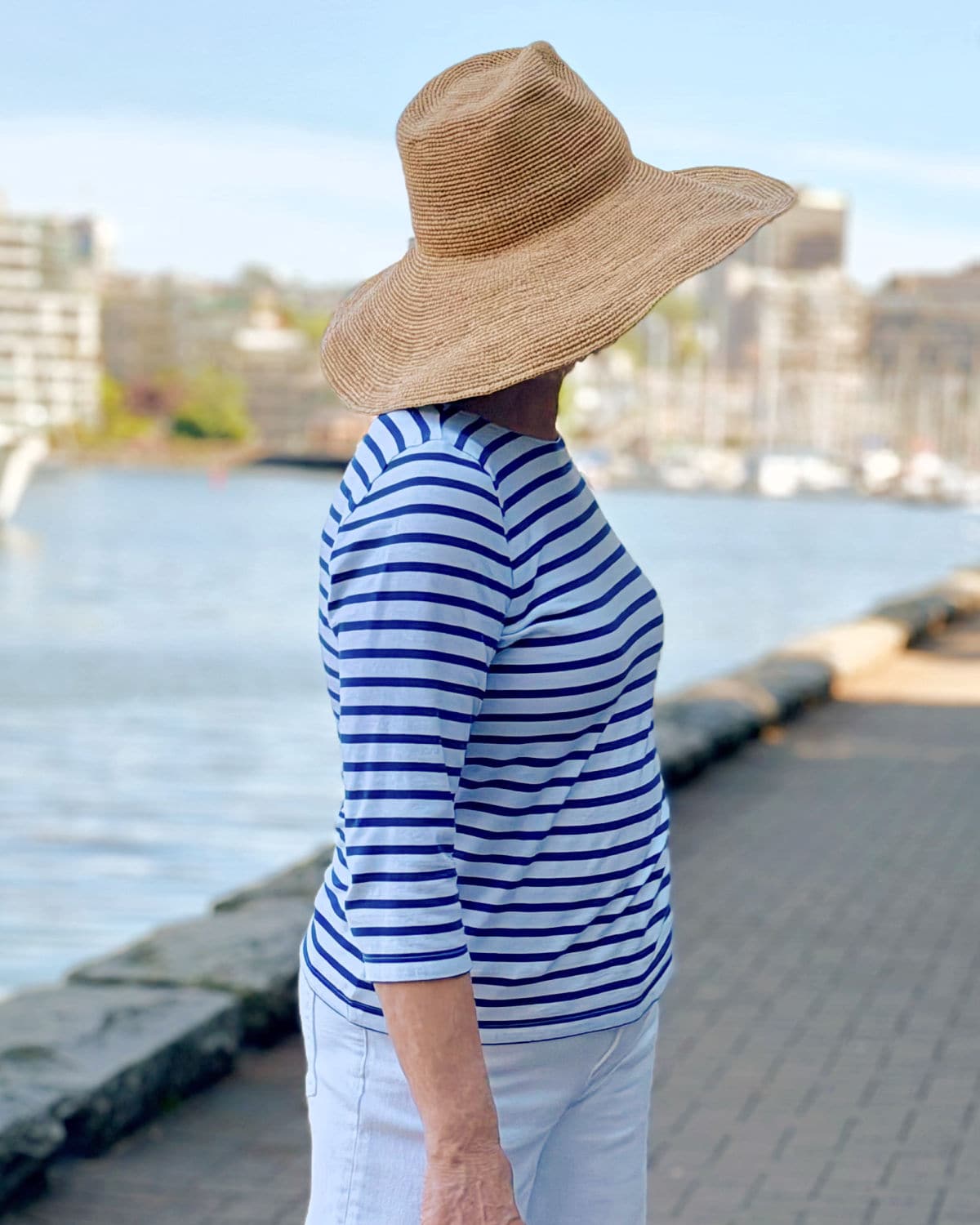
If I had to pick one sleeve length to recommend to most women over 50, it would be the 3/4 sleeve. It usually ends up on the narrowest part of the arm instead of the widest part of the upper arm, which is why it’s so flattering.
It also solves several common problems at once. You get protection over the upper arm and elbow, but your wrists remain visible, so the look doesn’t feel too confined.
Another reason why I love 3/4 sleeves is their versatility. They work with casual tees, striped tops, lightweight sweaters, linen shirts, and dresses. If you’re building a wardrobe, this is the length of one sleeve you’ll probably reach for over and over again.
If you already own long-sleeved shirts that feel tight or heavy, try pushing or rolling the sleeves up to 3/4 length. Sometimes that one small change makes the whole outfit look better, and you don’t have to buy anything new.
One thing you should pay attention to is where the sleeve sits. Not every product is a true 3/4 sleeve cut, especially if you are petite or have long or short arms. Ideally, it should hit between your elbow and wrist, where your arm is narrowest.
More 3/4 sleeve tops:
👉 Scroll right to see more options in the widget.
Elbow Length Sleeves

Elbow-length sleeves are another favorite of mine, especially in warm weather. They give you more coverage than a short sleeve without feeling hot or looking overly stuffy.
Fit is just as important as height. If the sleeve is too tight, it sticks to all the stitching when you walk. It’s very loose and boxy, and can make your entire upper body look wider. The sweet spot is a sleeve that flatters your arm without hugging it.
When shopping online, check product ratings or zoom in on the model. A sleeve defined as “elbow length” can vary slightly from one model to another.
I’ve had the best luck finding elbow-length sleeves at Chico’s and Talbots, although they’re becoming easier to find at other brands as well.
Other elbow length sleeves:
👉 Scroll right to see more options
Short Sleeves: Not the Enemy
This is when many women give up short sleeves and decide that their arms are the problem. Most of the time, they are not.
A typical short sleeve usually ends at the widest part of the upper arm, so that’s where your eye naturally goes. That’s the sleeve, not you.
Two things make a big difference. I always look for a diagonal hem instead of a single cut straight across, or a full or flared sleeve with enough movement so it doesn’t get caught. Both are more forgiving than a basic T-shirt sleeve.

Cap sleeves are not my first choice when trying to slim down my upper arms, as they draw attention to that area. That said, I still wear them occasionally when I like the rest of the outfit. I just know that they are the style of compromise that I am willing to do.
Sleeveless Tops: Is There an Age Limit?
No.
If you are comfortable wearing sleeveless tops, there is no reason to stop just because you have another birthday.
But I also know that many women are still not comfortable showing their arms, and I don’t think it helps when someone says, “Wear whatever you want.” It’s easy to say that if they don’t feel ashamed.
If you prefer a sleeveless dress but want more coverage, look for wider shoulder straps than spaghetti straps. They are usually more flattering, balance the shoulder better, and allow you to wear a regular bra without worrying about your straps showing.
Another option I rely on is layering a lightweight cardigan or wrap over a sleeveless dress or tank. You still get the coolness of a sleeveless dress without feeling overly revealing. It’s one of the reasons I keep lots of lightweight layers in my closet during the warmer months.

Don’t forget the Armhole
Sleeve length is not the only important detail. Pay attention to the armhole, too.
If it’s cut too low, it can open up, show off your bra, and add bulk under the armpit. If it’s too high, it can feel restrictive every time you walk.
Smaller sizes tend to have shallower holes, which can fit better even if you’re not very petite. If regular tops tend to open under the arm or show your bra, you may want to try a smaller version.
When you try something, don’t just stand in front of the mirror. Reach forward, raise your arms, and walk slowly. A well-cut armhole stays in place and moves with you. The one that is not cut well will not.
Fabric Is Important Too
Fabric is important, but not always in the same way. A soft, stretchy fabric can swing the arm and feel light, which is usually what I want in a pair of pants, blouse, or summer dress.
But strong fabric is not automatically bad. With a short sleeve or coat, it can add structure and keep the sleeve tight, which can be very fun. The problem is the stiffness in the wrong place, not the stiffness itself.
The best tests are simple: try it and move on. If the sleeve stays away in a clean, targeted way, that can work well. If it sticks out or pulls the upper arm, stop it.
The Bottom Line
Sleeve length may seem like a small detail, but it can completely change the way a top or dress looks on you. Before you decide that your arms are the problem, take a close look at where the sleeve ends, how the armhole fits, and how the fabric works with your body instead of against it.
You might be surprised to find that you don’t need to hide your arms at all. Sometimes you just need a better sleeve.
Have you found a sleeve length that you always feel good wearing? I’d love to hear what works for you.