
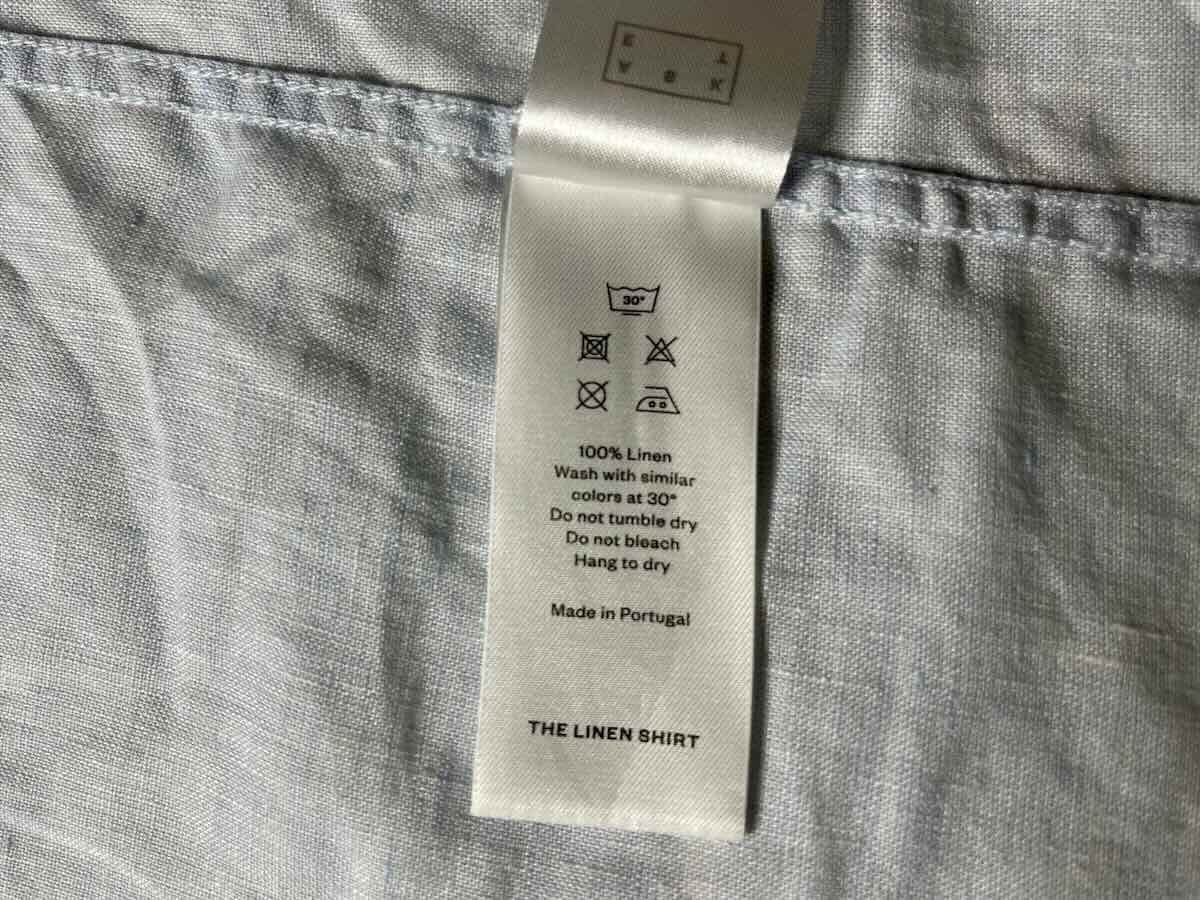

Gen Z turned “polyester” into an insult this year. The joke is that it looks fine in the store and falls apart in three months.
But the search behind the joke is older than the joke. TikTok reported around 9,000 posts tagged #NaturalFibers in the first half of 2025, up more than 230% year over year. People are checking labels now, and a lot of them are finding polyester in clothes they assumed were cotton.
So we did something we haven’t seen anyone else do. We went through all 120 brands in our certified directory, one at a time, and checked what they’re actually made of.
How we checked
| Brands checked | 120 (every brand in our certified directory) |
| Passed: no polyester in their fabrics | 42 |
| Polyester in part of the range | 47 |
| Polyester throughout | 24 |
| Not clothing(jewelry, eyewear, bags) | 7 |
| Brands that publish their thread type | 10 of 120 |
| → of those 10, sew with something other than polyester | 3 |
We read fiber compositions, materials pages and product labels, not marketing claims. Where a brand publishes a sustainability percentage, we checked what that percentage actually counts.
Our pass/fail rules:
- Polyester in the fabric at any percentage is a fail.Not 5%, not 2%. Thread and trims are noted, not disqualifying.
- Recycled polyester is still polyester.If you don’t want plastic on your skin, it doesn’t matter that the plastic used to be a bottle.
- Elastane up to 16% passes.It’s a compromise: elastane is a synthetic and makes recycling harder. Natural rubber can replace it in denim, waistbands and socks, but not yet in most performance wear. Most brands here are far under.
- Viscose, modal, lyocell and bamboo are flagged, not banned.No polyester, but not everyone counts them as natural.
What counts as polyester free?
People searching for this don’t all want the same thing. There are roughly three groups:
Group 1: No polyester.The most common position. Polyester is the thing they’re avoiding. A little elastane is fine.
Group 2: No synthetics at all.Also excludes elastane, spandex, nylon and acrylic.
Group 3: No semi-synthetics either.Also excludes viscose, rayon, modal, lyocell and bamboo, because those are chemically regenerated from plant cellulose.
This guide is written for Group 1. If you’re in Group 2 or 3, our brand directory now filters for you directly:Natural Fibers Onlyreturns the brands using no polyester, no elastane and no cellulosics at all. A brand that’s perfect for one group is often wrong for another.
Some context on what you’re up against. Textile Exchange’s 2024 figures put global fibre production at 132 million tonnes, of which polyester alone accounts for 59%, up from 57% the year before. Cotton fell to 19%. Of the 78 million tonnes of polyester made that year, roughly 9.3 million tonnes was recycled, about 12%.

Quick comparison: 30 non polyester clothing brands
Price key:$under $50 ·$$$50 to $150 ·$$$above $150. Based on the linked category, not the cheapest item in the range.
| # | Brand | Best for | Max elastane | Thread | Price |
|---|---|---|---|---|---|
| 1 | Boldwill | Natural sportswear | Bio-based, fitted pieces | TENCEL | $$ |
| 2 | MUD Jeans | Circular denim | 3% | Polyester core | $$ |
| 3 | ZONE by Lydia | Hemp activewear | 5% | Not published | $$ |
| 4 | Everywhere Apparel | Recycled cotton blanks | 0% | Not published | $ |
| 5 | The Classic T-Shirt Co. | Premium tees | 0% | Not published | $$ |
| 6 | Tripulse | Performance leggings | 16% | Not published | $$ |
| 7 | Jackalo | Kidswear | 0% | Not published | $$ |
| 8 | JulieMay | Bras and lingerie | 0% | Cotton | $$ |
| 9 | SANVT | Shirts & essentials | 0% | Not published | $$ |
| 10 | Beckett Simonon | Leather sneakers | n/a | Not published | $$$ |
| 11 | Adelante | Made-to-order leather shoes | n/a | Not published | $$$ |
| 12 | Ninety Percent | Timeless womenswear | None listed | Not published | $$ |
| 13 | BAM Bamboo | Bamboo activewear | 12% | Not published | $$ |
| 14 | Etiko | Vegan sneakers | n/a | Not published | $$ |
| 15 | Happy Earth | Hoodies and sweats | 5% | Not published | $$ |
| 16 | Triarchy | Stretch denim, no plastic | 0% (natural rubber) | Not published | $$$ |
| 17 | AlterX Co. | Hemp tees | 0% | Not published | $ |
| 18 | Kowtow | Everyday, zero compromise | 0% | Organic cotton | $$-$$$ |
| 19 | Citizen Wolf | Custom-fit basics | 0% | Not published | $$ |
| 20 | No Nasties | Affordable everyday | 0% | Not published | $ |
| 21 | Ecologyst | Outdoor knitwear | 0% | Not published | $$$ |
| 22 | Artknit Studios | Sweaters and knitwear | 0% | Not published | $$$ |
| 23 | Another Tomorrow | Luxury tailoring | Not published | Not published | $$$ |
| 24 | Opok | Men’s underwear | 5% | Not published | $ |
| 25 | CHNGE | Heavyweight organic cotton | 0% | Not published | $$ |
| 26 | Just Tall | Tall menswear | 0% | Not published | $ |
| 27 | The Glade | Mono-material only | 0% | Not published | $$ |
| 28 | ISTO | Shirts & tees | 0% | Not published | $$$ |
| 29 | atavío | Oaxacan handwoven | 0% | Not published | $$ |
| 30 | Viajante | Zapotec handwoven | 0% | Not published | $$ |
Almost all clothing is sewn with polyester thread and few brands publish it. Bold entries are the three that confirm they use something else.
30 polyester free clothing brands, in detail
Ujo Shop is reader-supported. We only feature fashion brands that pass our sustainable brand criteria.Learn more here.
1. Boldwill

Verdict: the most transparent brand in activewear.95% plastic-free across the collection, and they say openly that leggings are the exception. Where they use stretch it’s bio-based CREORA, spun as a core thread wrapped in natural fiber so friction never reaches it. They also use TENCEL Lyocell sewing thread in more than 90% of products, which almost nobody does. Hemp, GOTS organic cotton, TENCEL and natural rubber elastic. Their sports bra ships with a recycled polyester spacer, but it’s removable and you can untick it at checkout to skip it entirely. The bra itself, including thread and elastic, has no polyester. Their EX.01 sports sock is 94% organic cotton and 6% natural rubber, the only fully natural sock we found.
Shop Boldwill Activewear· $$
2. MUD Jeans

Verdict: they solved stretch without plastic, and they’ll take the jeans back.Their Natural Stretch denim gets its give from how the yarn is spun and woven rather than from added elastane, which almost nobody has managed. Where they do use stretch elsewhere it caps at 3% recycled elastane. Most denim is 60 to 75% OCS organic cotton topped up with recycled cotton, and some pieces contain 30% French hemp. Buttons and rivets are recycled stainless steel, so there’s no plastic hardware either. They also disclose that their stitching yarn has a polyester core, which is more than almost any brand on this page does.
Shop MUD Jeans· $$
3. ZONE by Lydia

Verdict: the best proof that activewear doesn’t need plastic.Hemp yoga pants and bralettes at 53% hemp, 42% organic cotton, 5% spandex. Their underwear uses just 3%, and they explain it’s there only so the garment returns to shape. For comparison, a typical recycled-polyester legging can run over 20% spandex on top of the plastic. Founded by a five-Olympic-cycle athlete who moved off synthetic kit.
Shop ZONE by Lydia Leggings & yoga pants· $$
4. Everywhere Apparel

Verdict: the sharpest anti-polyester brand we found.Their blanks are CirCot, 100% GRS-certified recycled cotton, made in Los Angeles and climate-neutral certified, with no water, chemicals, dyes or bleaching used in fibre production. The distinction they draw is the one this article keeps coming back to: other recycled clothing companies use recycled polyester from plastic bottles and call it eco-friendly, and those poly-cotton blends shed microplastics and can’t be recycled. Recycled cotton and recycled textiles are not the same thing. Every shirt carries a QR tear-off tag so it can be recycled at end of life.
Shop Everywhere Apparel Basics· $
5. The Classic T-Shirt Company

Verdict: buy this if you only want one great white tee.Tees and nothing else, all 100% GOTS certified organic cotton, made in the USA and handcrafted by fair-trade workers, pre-washed and pre-shrunk so they hold their shape. Being a single-category brand is exactly why they’re clean: no activewear line, no socks, no outerwear to create an exception. Worth checking heather greys, since that’s the one colourway where a cotton tee line usually hides viscose or polyester.
Shop The Classic T-Shirt Company Tees· $$
6. Tripulse

Verdict: best technical performance, if you accept the elastane.Zero polyester. Leggings are 86% TENCEL with 14% ROICA recycled elastane, and waistbands are 60% organic cotton and 40% natural rubber. Their Original leggings hit 16%, right at our ceiling. We mention it because they’d rather you knew, and because their ROICA V550 is designed to break down over time, unlike regular elastane, and holds a Cradle to Cradle Material Health Gold certificate. Their own materials page is upfront that full degradation hasn’t been verified yet.
Shop Tripulse Leggings· $$
7. Jackalo

Verdict: best kidswear, and built to be handed down.GOTS organic cotton, deadstock linen and upcycled denim. They explicitly avoid fabric blends so garments can be recycled or composted with existing machinery, and use no chemical fabric treatments at all, which means no added PFAS, formaldehyde or phthalates. They buy the clothes back when your kid outgrows them.
Shop Jackalo kids· $$
8. JulieMay

Verdict: the hardest problem on this list, solved.GOTS organic Pima cotton with mulberry peace silk lining, cotton thread, cotton lace, cotton trims, and padding filled with organic cotton rather than synthetic foam. Elastane free. They’re honest about the tradeoff: less stretch, so the sizing works differently. Bras are the hardest garment in the wardrobe to make without synthetics, between the underwire casing, straps, padding and stretch. Allergy UK accredited.
Shop JulieMay Bras· $$
9. SANVT

Verdict: 100% plastic-free, in their own words.Their Oxford shirt is 100% certified organic cotton, made in a factory near Porto. The fabric was engineered to hold its shape without synthetic stretch, which is the usual reason a shirt ends up with elastane in it. Munich-based, with a small, deliberately unseasonal range built around perfect-fit basics.
Shop SANVT business essentials· $$
10. Beckett Simonon

Verdict: the leather sneaker to buy if you don’t want synthetics inside your shoe.Full-grain Italian calfskin uppers, and every pair, sneakers included, is lined with a wholecut piece of Vachetta leather instead of the synthetic mesh most sneakers use. The insoles are leather lined too, the soles are natural rubber, and every pair is handmade to order in their own Bogotá workshop, so nothing is overproduced. Their dress shoes go further still, with vegetable-tanned leather outsoles and stacked leather heels.
Shop Beckett Simonon Men’s Sneakers· $$$
11. Adelante

Verdict: made-to-order leather, and we’ve seen the workshop ourselves.All-leather construction, made to order in Guatemala. We’ve visited the workshop repeatedly and interviewed the owner on camera, which is a higher bar than reading a materials page. Leather throughout means none of the synthetic linings or mesh that make most footwear hard to buy polyester free.
Shop Adelante Women’s Boots· $$$
12. Ninety Percent

Verdict: one of the clearest fiber disclosures in womenswear.Their published fiber list contains no polyester at all: GOTS organic cotton, TENCEL, ENKA viscose, MicroModal, EcoVero and linen. Buttons are BioResin made from tree and plant material, or corozo palm nut, specifically to replace plastic. Named for their model of distributing 90% of profits to workers and a cause of your choosing. Note their zip tape is either organic cotton or recycled polyester depending on the style.
Shop Ninety Percent Dresses· $$
13. BAM Bamboo

Verdict: best bamboo activewear, with one caveat.BAM publishes exact compositions for every fabric and no polyester appears in any of them. The range runs from 90% bamboo modal with 10% elastane to 68% bamboo viscose, 28% cotton, 4% elastane. PFAS-free. The caveat: bamboo viscose is a regenerated cellulosic, so if you’re avoiding viscose and rayon this one’s out, and their high-performance fabric contains a biodegradable polyamide.
Shop BAM Bamboo Bestsellers· $$
14. Etiko

Verdict: best vegan sneaker.Organic cotton and natural rubber, about as simple as footwear construction gets. Fairtrade certified, Australian, ships internationally. Their apparel range is organic cotton too.
Shop Etiko Sneakers· $$
15. Happy Earth

Verdict: the hoodie pick, and it matters more than it sounds.Their hoodies, crews and quarterzips are 100% organic cotton fleece. The fleece hoodie is the single hardest everyday garment to buy without polyester, because the standard “organic cotton” fleece many brands buy from blanks suppliers is 80/20 cotton to recycled polyester, and the heather grey version is closer to 55/45. Happy Earth runs “ditch the polyester sweatshirts” as standing copy and backs it up.
Shop Happy Earth Hoodies & sweatshirts· $$
16. Triarchy

Verdict: buy this if you want stretch jeans without plastic.They developed a stretch denim that’s plastic-free and therefore biodegradable, using natural rubber in place of elastane. Organic and recycled cotton, Tencel and Candiani denim, low-impact dyes, recycled wash water. They also run a campaign called #HowMuchPlasticAreYouWearing, which tells you where their head is.
Shop Triarchy Women’s jeans· $$$
17. AlterX Co.

Verdict: best hemp tee.60% hemp, 40% organic cotton, made in Los Angeles. Tees and nothing else, which is exactly why they’re clean: no activewear, socks or outerwear to create an exception. They donate 20% of profits.
Shop AlterX Co. Tees· $
18. Kowtow

Verdict: the most thorough brand we found, full stop.In August 2023 they replaced the industry-standard polyester-cotton thread with 100% GOTS organic cotton thread. They also swapped synthetic elastic for natural rubber encased in organic cotton, replaced every synthetic interlining with organic cotton, and use agoya shell, mussel shell or corozo nut buttons. They removed elastane from the line entirely. Of 120 brands we checked, few brands went this deep.
Shop Kowtow Tops· $$-$$$
19. Citizen Wolf

Verdict: the clearest refusal of polyester of any brand here.Straight from their homepage: 100% natural fibres only, and they never use fabrics blended with petro-yarns like polyester. Organic cotton, hemp and merino, all GOTS or RWS certified, custom made to order in their Sydney factory so nothing is overproduced. Because everything is one fiber, they take old garments back and turn them into new fabric.
Shop All Citizen Wolf· $$
20. No Nasties

Verdict: the most on-the-nose brand on this list, in a good way.“No polyester, no pesticides, no child labour, no greenwashing” runs as standing copy across their site. GOTS organic cotton sourced from small-scale Indian farmers, plus linen and upcycled material. Vegan, affordable, and about as unambiguous as a brand can be about what it won’t use.
Shop All No Nasties· $
21. Ecologyst

Verdict: the natural-fiber answer to Patagonia.Their materials page is titled “100% Natural Fibres” and means it. Organic cotton, ZQ certified merino, Climate Beneficial wool, cashmere, linen and waxed cotton, with no synthetic named anywhere. They own their factory in Victoria, BC, so the composition control is real rather than claimed. Their sweatpants are 100% organic cotton fleece milled in Ontario.
Shop Ecologyst Merino & knitwear· $$$
22. Artknit Studios

Verdict: best sweaters, and rarer than it looks.Merino, cashmere, organic cotton and linen only, with bio-resin buttons, made in Italy through a short supply chain. They state their knitwear is 100% biodegradable with no microplastic release. Nylon in the blend is close to standard in Italian knitwear, so avoiding it is a deliberate choice rather than a happy accident.
Shop Artknit Studios Sweaters· $$$
23. Another Tomorrow

Verdict: the luxury pick.Rather than work around the problem they rebuilt their supply chain, publishing both a materials-we-use and a materials-we-don’t-use list. The fabrics are organic cotton, organic hemp, European linen, ethically sourced wool, peace silk, GRS recycled cashmere, FSC certified viscose and Seacell. Every garment carries a digital ID you can trace back to the farm, and they were the first luxury brand to become a Certified B Corp. One honest caveat, which they flag themselves: some of their buttons are recycled polyester, and they say they still struggle with trims and are working on it. The fabric is clean; a button may not be.
Shop All Another Tomorrow· $$$
24. Opok

Verdict: best men’s boxer brief.95% GOTS organic cotton, 5% elastane, dyed with GOTS certified organic pigments. The detail we liked: their waistband liner is 100% organic cotton, and the waistband is exactly where many underwear brands quietly put nylon. Founded by two former Team USA water polo players.
Shop Opok Boxers· $
25. CHNGE

Verdict: best heavyweight organic cotton.100% GOTS certified organic cotton across the core collection, including a 550 GSM French terry that’s about as substantial as sweatshirt fabric gets. The cotton is grown organically in Turkey and produced at a Fairtrade factory in Denizli, with traceability back to the field. No polyester anywhere in the range, which matters most in exactly what CHNGE specializes in: heavyweight sweats, where many brands quietly blend in recycled polyester for structure.
Shop CHNGE Hoodies· $$
26. Just Tall

Verdict: best for tall, slim men.100% organic cotton, cut specifically for a fit almost nobody else serves. Most sustainable brands size for the middle of the curve and leave tall men with short sleeves and high hems. Just Tall exists to fix that, and does it without reaching for synthetic stretch to cover fit problems.
Shop Just Tall Tees· $
27. The Glade

Verdict: the strictest sourcing rules of anyone here.Three published rules: a traceable supply chain, a biodegradable cellulose fiber, and a pure mono-material, non-blended, because mixed fabrics complicate recycling. That last rule eliminates polyester, elastane and every hidden blend problem in one move. Currently 100% TENCEL and 100% recycled cotton, dyed with low impact dyes and treated wastewater.
Shop The Glade· $$
28. ISTO

Verdict: best value in premium basics.They publish the cost of every component in every garment, which almost nobody does. The Classic T-Shirt is 100% GOTS organic cotton at 180gsm, and the undyed version takes its colour entirely from the raw fibre with no chemicals at all. Shirting is organic Portuguese cotton, 100% French linen from Normandy, and an organic cotton and cashmere flannel. Buttons are custom bio-resin rather than plastic.
Shop ISTO Shirts· $$$
29. atavío

Verdict: handwoven in Oaxaca, and we verified it in person.Natural fibers only, made by hand in Oaxaca, Mexico. There’s no published composition data online because there’s no online store yet, so we checked this one ourselves on site rather than taking a materials page at its word.
Contact atavío on Instagram to Shop· $$
30. Viajante

Verdict: Zapotec handloom, also verified in person.Natural fibers only, woven by a Zapotec family in Mitla, Oaxaca. Same situation as atavío: no e-commerce, no published materials page, verified on a visit in Oaxaca.
Contact Viajante on Instagram to Shop· $$
Want the other 12?
These 30 are the ones we’d point a friend to first, but they aren’t the whole list. 42 brands passed.
We’ve built the full results into our brand directory as two filters you can stack with everything else:
Combine them with the filters you already care about. Polyester-Free Fabrics plus Womens plus Activewear narrows 120 brands to a handful in three clicks, which is faster than any article can be.
If you also avoid viscose and rayon

Several brands here contain no polyester but rely on regenerated cellulosics. If you’re in Group 2 or 3, here’s the short list.
The fastest way to shop this is theNatural Fibers Onlyfilter in our directory, which returns the 24 brands that use no polyester, no elastane and no regenerated cellulosics. From the 30 above, these qualify: Everywhere Apparel, The Classic T-Shirt Company, Jackalo, JulieMay, SANVT, Beckett Simonon, Adelante, Etiko, AlterX Co., Kowtow, Citizen Wolf, No Nasties, Ecologyst, Artknit Studios, CHNGE, Just Tall, ISTO, atavío and Viajante.
Contains cellulosics(TENCEL, modal, viscose or bamboo): Boldwill, Tripulse, Ninety Percent, BAM Bamboo, Another Tomorrow, The Glade, Triarchy.
Contains elastane:Tripulse up to 16%, BAM up to 12%, Happy Earth 5%, Opok 5%, ZONE by Lydia 5%, MUD Jeans 3%, Boldwill, bio-based, in fitted pieces (11% in their sports bra).
If you avoid synthetics but you’re happy with TENCEL and other plant-based fibers, Triarchy, The Glade and Ninety Percent fit too. None of them use elastane.
The cheapest way to buy polyester free
Everything above costs money, and sometimes real money. So here is the part we would tell a friend.
The cheapest polyester free wardrobe is secondhand, and it isn’t close.
It also has an advantage new clothing doesn’t. Older clothing generally contains more natural fiber than what is made today. A thrifted wool coat or a vintage cotton shirt is often a better fiber buy than a new “sustainable” equivalent, at a tenth of the price.
How to thrift for natural fibers:
- Read the label first, the garment second.
- Learn the burn test if you buy vintage without labels. A snipped thread from a seam allowance tells you everything: cotton and linen burn to fine grey ash and smell like paper, wool smells like burning hair and self-extinguishes, polyester melts into a hard bead and smells chemical. Do it outside, over a sink.
- Feel for the melt. Polyester and poly blends have a slick, slightly springy hand and recover instantly from a crush. Cotton and linen crease and stay creased.
- Check the usual suspects even on vintage: waistbands, linings and zip tape. A 1970s wool skirt with an acetate lining is still mostly natural, but know what you’re getting.
- Focus on categories where new polyester free options are expensive or nonexistent. Wool coats, tailoring, silk blouses, cashmere knitwear and formalwear are all far easier and cheaper to find secondhand than new.
Where to look: local thrift and charity shops for volume, eBay and Vinted if you can search by fabric in the listing text, and brand resale programs. Several brands in this guide run their own: Outerknown, Nudie Jeans and Jackalo all take garments back and resell them, which means you get a verified composition at a secondhand price. Citizen Wolf takes old garments back too, though they recycle them into new fabric rather than reselling.
The polyester hiding in your “100% cotton”

This is the part worth bookmarking.
A garment label lists the fabric. It does not list the thread, the elastic, the zip tape, the lining or the interfacing. Those are legally excluded as trims. So a shirt can say 100% organic cotton and still be sewn with polyester.
Thread.Almost all clothing is sewn with polyester thread. It is the industry default, it is strong and cheap, and very few brands disclose it because very few customers have ever asked. GOTS classifies sewing thread as an accessory rather than part of the fabric, explicitly permits virgin polyester there, and exempts accessories from the organic percentage entirely. So a garment can be certified 95% organic cotton and be sewn with polyester.
Keep this in proportion. Thread is a fraction of a percent of a garment’s weight, and the fabric is the other 99%. If you are avoiding polyester because of how a fabric feels, wears or sheds, the thread is not what you are reacting to.
That said, a handful of brands have gone after it anyway, and it is a fair signal of how deep a brand’s thinking goes. Three brands in our directory confirm they use something else: Kowtow (organic cotton), JulieMay (cotton) and Boldwill (TENCEL). Seven more state plainly that they use polyester thread, which is worth crediting, because publishing an unflattering detail nobody asked about is its own kind of transparency. The remaining brands simply do not publish it, which is normal rather than suspicious.
Waistbands and elastic.One well-regarded organic cotton underwear brand runs 95% cotton and 5% elastane in the brief, and 91% nylon in the waistband. Check the trim, not the panel.
Socks.Worth understanding rather than holding against anyone. Socks have to stretch over a heel, stay up all day and survive abrasion at the toe, and cotton on its own stretches out and wears through. That’s why GOTS permits up to 25% synthetic content in socks against 10% for most other products.
Several brands in our directory make clothing without polyester and still use synthetics in their socks, and that isn’t a lapse in judgement. It’s teams hitting the same wall.
The amounts vary a lot, though. One brand’s socks are about 5% polyester. A certified organic cotton sock brand runs 23% recycled polyester. Many use nylon rather than polyester for strength.
The exception is Boldwill’s EX.01 sports sock: 94% GOTS organic cotton and 6% natural rubber, the result of four years and more than fifty prototypes. It shows the wall can be climbed, and how steep it is.
Sweatshirts and fleece.A common “organic cotton” fleece from blanks suppliers is 80% cotton and 20% recycled polyester, and the heather grey version is 55/45. If your organic cotton hoodie is heather grey, check twice.
Suit linings.A 100% wool suit routinely has a lining, interfacing and pocket bags that are polyester or semi-synthetic, none of which appear in the headline composition.
Zip tape.The woven tape a zip is sewn onto is often polyester. Two brands in our directory named zippers as their last unsolved component.
Words that mean polyester.Watch for “elastomultiester,” which one denim brand defines on its own site as elastane blended with polyester. Also PLA or polylactide, a corn-derived plastic that is chemically a thermoplastic polyester. It turns up in plant-based leathers and some natural insulation.
Why “95% sustainable” doesn’t mean 95% natural
“Sustainable materials” or “preferred materials” can and often do include recycled synthetics and recycled polyester.
For example, one brand reported 95% “preferred materials.” Their preferred list explicitly includes recycled polyester and recycled nylon. Another says their line is at least 80% “sustainable fibers,” where sustainable includes recycled synthetics.
None of these are lies. In short, sustainable materials doesn’t necessarily mean natural materials, which is exactly why we wrote this article.
Great brands where you need to know what to buy
These brands aren’t polyester free, but writing them off would send you past clothes you’d actually want. In most cases the polyester sits in one or two categories and the rest of the range is natural fibers.
Find your brand, buy the left column, skip the right one.
Denim
| Brand | Buy this | Skip this |
|---|---|---|
| Nudie Jeans | All denim. The rigid range is 100% organic cotton with no elastic fibre at all; stretch fits stay at 1–2% elastane. Monomaterial by design so it can be recycled, plus free repairs for life. | Outerwear. The Willy Suede jacket has a recycled polyester sleeve lining; the Peggy uses recycled polyamide. |
| Outland Denim | Most jeans — organic cotton with about 2% elastane. Founded to employ women survivors of trafficking. | The styles containing recycled polyester. Check the composition per product. |
Outdoor and technical
| Brand | Buy this | Skip this |
|---|---|---|
| Patagonia | The organic cotton and hemp ranges. | Anything technical. Virgin and recycled polyester run through most of the line. |
| Picture Organic | The casual line. 92% of the cotton they use is organic, made at a separate factory in Izmir. | Technical jackets, which contain a minimum of 50% recycled polyester. |
| Finisterre | Organic cotton tees and sweatshirts, British merino base layers, and wetsuits made with Yulex natural rubber instead of neoprene. | Waterproof jackets and insulated pieces. |
| prAna | The Organic Cotton Collection, stated as 100% organic cotton, and their Regenerative Organic Certified cotton sweaters. | Stretch and technical styles, which blend hemp with recycled polyester and spandex. |
Basics and everyday
| Brand | Buy this | Skip this |
|---|---|---|
| KNOWN SUPPLY | All clothing. Tees, hoodies, sweaters, cardigans and waffle dresses are 100% GOTS organic cotton, each signed by the person who made it. | Hats, accessories and outerwear, where the recycled polyester lives. |
| ASKET | The 100% natural fibre pieces, which is most of the range: cotton, wool, merino and linen essentials. They publish composition and origin for every garment down to the farm, mill and button, so this is the easiest brand on this page to check for yourself. | Styles made with recycled polyester or nylon, including a fabric made from plastic waste recovered from the Mediterranean. |
| Yes Friends | Tees, shirts, denim, trousers, underwear and pyjamas, all Fairtrade and GOTS organic cotton at the lowest prices on this page. Their Organic Leggings and Base Layer too. | The YF. Sport activewear line, and one fleece. |
| Taylor Stitch | 99% of the range. Hemp, organic cotton, linen and merino. | The Heavy Bag tees and henleys, which blend upcycled cotton with recycled polyester. |
| MATE the Label | All apparel. No polyester anywhere, spandex capped at 8%. | Socks, which are 17% nylon despite their pledge never to use polyamide. |
| Vustra | Their organic cotton, linen and hemp shirts — GOTS certified Italian and Turkish cotton. | Newer styles containing recycled polyester. Check the composition per shirt. |
| Suitsupply | Suiting, shirting and knitwear. Wool dominates, with linen, silk, cotton, cashmere and mohair across the range, and they state a preference for natural fibres. | Padded and technical outerwear. Note that suit linings are rarely disclosed by any brand, and are usually cupro or viscose. |
| Ecoalf | T-shirts and sweatshirts made from 100% recycled cotton, plus their organic cotton, linen and Tencel pieces. | Outerwear and shoes, which are built on recycled polyester. |
| Kotn | Clothing. Egyptian cotton and linen, with chain of custody back to the farms. | Socks, though some contain only around 5% polyester. |
Underwear
| Brand | Buy this | Skip this |
|---|---|---|
| KNOWN SUPPLY | Their organic cotton women’s underwear, part of a clothing range that’s GOTS organic cotton throughout. | Hats, accessories and outerwear, which is where their recycled polyester sits. |
| Subset | The briefs, which are 95% GOTS organic cotton and 5% elastane. | The bralettes, which have polyester in the band. And note the brief’s waistband is 91% nylon, so these are polyester free but not synthetic free. |
Kids
| Brand | Buy this | Skip this |
|---|---|---|
| Little Green Radicals | Everything except outerwear. GOTS organic and Fairtrade cotton, with only a small percentage of elastane in a few styles. | Rainwear, waterproof all-in-ones and winter coats, all 100% recycled polyester. |
| Mightly | The “Mightly (Certified)” collection. 100% GOTS organic cotton, Fair Trade certified, no chemical flame retardants in the pajamas. Baby, pjs, tees, leggings, socks and underwear all sit here. | The Rockets of Awesome collection, the brand they acquired. Its existing stock isn’t certified and the relaunch uses recycled polyester in activewear, outerwear and swim. |
Shoes
| Brand | Buy this | Skip this |
|---|---|---|
| Veja | Organic cotton canvas models and the corn-based C.W.L. styles. | B-mesh models, which use recycled plastic bottles. |
| 8000Kicks | Nothing, if polyester is your line. Every product is at least 55% hemp but the balance includes recycled polyester. | The brand states it blends hemp with recycled polyester, nylon and elastane. Their ankle socks are 40% polyester. |
Does recycled polyester count as polyester?
Yes. If your reason for avoiding polyester is that you don’t want plastic on your skin, or your washing machine shedding microfibers, the origin of the plastic is irrelevant. Recycled, upcycled, deadstock or secondhand, it behaves the same way.
The brands agree. A Swedish brand that uses recycled polyester states on their own site that whileit has environmental benefits over virgin, it still sheds microplastics, then recommends a washing bag. An activewear brand built entirely on recycled bottles sells a microfiber-catching bag alongside the leggings. Eight brands in our directory acknowledge shedding in their own words, and all eight use synthetics.
The counter-argument deserves a hearing. A lingerie brand that uses recycled polyester points out it needs about 90% less water than virgin polyester, and far less than cotton. They’re right. A single cotton shirt can take more than 700 gallons of water to produce, and the cotton industry helped drain the Aral Sea. Polyester is less resource-intensive to make but generates more emissions because it starts as oil.
No fiber wins on every measure. Choosing natural fibers is a trade, not a free upgrade. What you’re buying, especially in garments with little or no elastane, is one that biodegrades, can actually be recycled, and doesn’t shed plastic every time you wash it.
That last point is the one brands keep making themselves. Blends break recycling. A cotton-polyester shirt cannot be reprocessed the way a cotton shirt can, because the two materials have different melting points and different chemistry. Several brands in our directory arrived at that conclusion independently.
What about the polyester you already own?
That depends on why you’re avoiding it.
If your reason is environmental, keep wearing it.The footprint of a garment is mostly in making it. Throwing out a working polyester jacket to buy a cotton one means two garments were made instead of one. Wear it until it’s done, then replace it with something from this list.
If your reason is how it feels, you don’t have to.Plenty of people stop wearing polyester because it runs hot, holds onto odor, bothers their skin, or they just don’t like it. Those are good reasons. What matters is what happens next: pass it on instead of throwing it out. Sell it, swap it, or give it to someone who’ll actually wear it. The garment keeps doing its job, the resources that went into making it aren’t wasted, and it’s off your body. Resale and handing things to people directly tend to work better than donation bins, where only a small share of clothing actually gets resold. Our guide to sustainable ways to get rid of old clothes covers every option, including what to do with pieces too worn to pass on.
Start with what touches your skin most.If you’re replacing gradually, go in order of contact: underwear, base layers and workout clothes first, then everyday tops and sleepwear. Leave outerwear for last. A polyester rain shell barely touches your skin and is doing a job polyester is genuinely good at.
Whatever you keep, look after it.Wash less and wash cold, since most shedding happens in the machine. Use a filter bag or a machine filter; several brands that sell polyester also sell these, which tells you they work. Skip the dryer, which accelerates shedding and pilling.
The most sustainable garment is one that already exists. If you don’t want to wear it, let someone else.
Frequently asked questions
Is 95% organic cotton, 5% elastane polyester free?Yes. Elastane and spandex are synthetics but they are not polyester. Natural rubber can replace them in some garments, but not yet in most stretch fabrics. Most people avoiding polyester accept a small amount. We set our cutoff at 16%, and most good brands come in far under.
Is recycled polyester still polyester?Yes. Chemically identical. It sheds microfibers the same way and doesn’t biodegrade. The environmental case for recycled polyester is real, but it doesn’t make the garment polyester free.
Are bamboo, viscose and Tencel polyester free?
Yes. They’re all made from plant cellulose, chemically regenerated rather than spun directly from the plant, and contain no polyester. Whether they count as “natural” depends on where you draw the line. TENCEL Lyocell uses a closed-loop process and is generally considered the best of them.
Is Piñatex polyester free?No. Piñatex is roughly 72% pineapple leaf fiber, 18% PLA and 10% polyurethane coating. PLA is a corn-derived thermoplastic polyester. Better than PVC-based vegan leather, but not plastic free.
Does GOTS certified mean no polyester?No. GOTS caps synthetic content at 10% for most products, but allows up to 25% for socks, leggings and sportswear. Sewing thread and other accessories are exempt from the calculation entirely, and virgin polyester thread is explicitly permitted. GOTS is a strong certification for what it covers. It does not mean the garment is polyester free.
Should I throw out my polyester clothes?Not into the bin. If your concern is environmental, wear them until they’re done, since most of a garment’s footprint is in making it. If polyester bothers you, pass it on through resale, swaps or someone who’ll wear it, starting with whatever sits closest to your skin. Here are six sustainable ways to get rid of old clothes.
What’s the cheapest way to buy polyester free clothing?Secondhand. Older clothing generally contains more natural fiber than new clothing. Read the label before you look at the garment, and focus on wool coats, tailoring and knitwear where new natural-fiber options are most expensive.
Why do most sock brands use synthetics?Because socks have to stretch, stay up and resist abrasion at the toe, and cotton alone does none of those well for long. The exception we found is Boldwill’s EX.01, which uses natural rubber instead. GOTS permits up to 25% synthetic content in socks for exactly this reason, against 10% for most other products. Amounts range from around 5% to over 20%, so it’s worth checking the number rather than assuming.
Which category is hardest to buy polyester free?Occasionwear, swimwear and technical outerwear, in that order. Bridesmaid dresses and formalwear are almost universally polyester chiffon and satin. Travelwear is also difficult, because wrinkle resistance and packability are exactly what polyester does best.
The simplest rule

After checking 120 brands, the most useful signal wasn’t certification, price or marketing.
It was how easy the brand made it to find out what their clothes are made of.
The brands on this list publish their fiber compositions clearly, and several go further and publish their trims, their exceptions and the places they haven’t solved yet. That made them easy to recommend. Plenty of other good brands simply publish less, which usually means nobody has asked them for it rather than that something is being hidden.
So the rule is simpler than it sounds. Read the composition label. If it’s easy to find and it says cotton, linen, hemp, wool or Tencel, you’re most of the way there.
Want to go deeper on fabrics? Read our guide to natural fiber clothing and our guide to organic cotton underwear. Or browse all 120 certified brands in our directory.
Article last updated: 09/25/2026.

Garik Himebaugh is the founder of Ujo Shop, the go-to resource to find ethical clothing. He’s also a sustainable personal stylist and international speaker on all things sustainable fashion. Garik loves coffee, climbing, and clothes.